
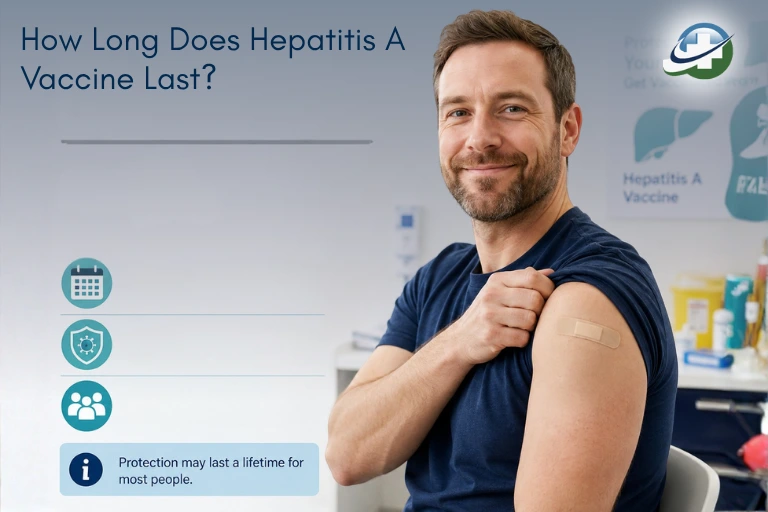
If you’ve recently got the Hepatitis A vaccine or are planning to get it, one of the most common questions people have is: how long does the Hepatitis A vaccine last? It’s a fair question, and the answer is actually quite reassuring. This guide walks you through everything you need to know, from how the vaccine works to how long its protection holds up over time.
What Is the Hepatitis A Vaccine?
Hepatitis A is a liver infection caused by the Hepatitis A virus. It spreads through contaminated food and water, or close contact with an infected person. While it’s rarely fatal, it can make you seriously ill for weeks or even months.
The Hepatitis A vaccine is an inactivated (killed) virus vaccine. That means it introduces your immune system to the virus without actually infecting you. Your body learns how to fight it, and if you’re ever exposed later in life, your immune system is ready to respond quickly.
The vaccine is widely recommended for travelers, young children, healthcare workers, and anyone in higher-risk situations. It has been part of routine childhood immunization schedules in many countries for years, and it works extremely well.
How Long Does the Hepatitis A Vaccine Last?
Here is the short answer: the Hepatitis A vaccine is believed to provide lifelong protection when you complete the full two-dose series.
After the first dose, your body builds a good initial level of immunity that typically protects you for at least 12 months. But here is where many people stop, and that is a mistake. The second dose, given 6 to 12 months after the first, dramatically boosts your immunity and is what makes the protection long-lasting.
Studies that have followed vaccinated individuals for more than 25 years show that antibody levels remain detectable and protective for decades. Based on mathematical modeling of how immunity behaves in the body, researchers and health authorities widely agree that protection likely lasts for 25 to 40 years or more, possibly for life.
So if you received both doses as a child, teenager, or adult, you are most likely protected for the rest of your life.
One Dose vs. Two Doses: Does It Matter?
Yes, it matters quite a bit.
A single dose of the Hepatitis A vaccine is enough to offer solid short-term protection. Most travel medicine clinics actually recommend getting at least the first dose one to two weeks before traveling to a high-risk area, and that alone provides a reasonable level of cover.
However, the second dose is what truly locks in long-term protection. Think of it this way: the first dose teaches your immune system who the enemy is. The second dose is the training session that makes sure your immune system never forgets.
If you only received one dose years ago and never went back for the second, it is worth speaking to your doctor or a travel health clinic. You may still be partially protected, but getting the second dose would give your immune system the reinforcement it needs.
Do You Need a Booster Shot?
For most healthy people who received both doses, no booster shot is currently recommended.
This is one of the things that sets the Hepatitis A vaccine apart from some others. You do not need to get it every few years like some other travel vaccines. Health authorities including the CDC and WHO do not recommend routine booster doses for people who completed the two-dose series.
That said, if you are immunocompromised or have a chronic liver condition, your doctor might recommend checking your antibody levels periodically to confirm you are still protected. In those cases, individual guidance from a healthcare provider matters more than general rules.
How Quickly Does the Vaccine Start Working?
Most people develop protective levels of immunity within two to four weeks of the first dose. That is why if you are planning a trip, doctors recommend getting vaccinated at least a month before you travel.
If you are traveling in less than two weeks and haven’t been vaccinated, you may still benefit from the first dose. Some protection is better than none, and your doctor may also discuss other precautions alongside it.
Who Should Get the Hepatitis A Vaccine?
The Hepatitis A vaccine is recommended for a broad range of people, including:
Children: Most countries now include it in routine childhood immunization programs. Children typically receive two doses starting around 12 to 23 months of age.
Travelers: Anyone traveling to parts of the world where Hepatitis A is more common, particularly regions in Africa, Asia, Central and South America, and Eastern Europe.
People with liver conditions: Chronic liver disease increases the risk of serious complications if Hepatitis A infection occurs, so vaccination is strongly advised.
Healthcare and food workers: Those in close contact with large numbers of people, especially in healthcare or food service settings.
People in higher-risk environments: Including those living in areas with poor sanitation or where outbreaks have been reported.
If you are unsure whether you need the vaccine, checking with your GP or a travel health clinic is always the right move.
What If You Are Not Sure Whether You Were Vaccinated?
This is more common than you might think. Many people simply do not remember whether they received one dose or two, especially if they were vaccinated as a child.
In this case, there are a couple of options. A blood test can check your Hepatitis A antibody levels to see if you already have immunity. If the results show you are protected, there is nothing more to do. If not, starting or completing the vaccine series is straightforward and safe.
Receiving an extra dose of the vaccine when you already have immunity is not harmful, so some doctors may simply suggest restarting the series rather than doing a blood test, especially if you are preparing for travel.
How Long Does Hepatitis A Vaccine Last in Children?
The good news is that the same long-term protection that applies to adults also applies to children who complete both doses. Studies tracking children who were vaccinated in early childhood show that antibody levels remain strong well into adulthood.
Children vaccinated as toddlers are expected to carry protection through their teenage years and into adulthood without needing a booster. This makes early vaccination a sensible investment in long-term health.
Can the Vaccine Wear Off?
While no vaccine is 100% permanent forever, the current evidence strongly suggests that a complete two-dose Hepatitis A vaccine series provides protection that lasts for decades. The antibody response after the second dose is particularly robust.
Researchers have modeled immune responses using what is known about how the body retains memory of viruses and vaccines. Their projections consistently point to protection lasting well beyond 25 years, with many studies suggesting it may last a lifetime for most people.
This is different from vaccines like the flu shot, which needs to be updated each year because the virus itself changes. The Hepatitis A virus is stable, which means the vaccine remains effective against it over long periods.
Frequently Asked Questions (FAQs)
How long does the Hepatitis A vaccine last after one dose?
After a single dose, protection typically lasts for at least 12 months. To achieve long-term or lifelong protection, the second dose is essential.
Do I need to get the Hepatitis A vaccine again after 10 years?
No. If you completed both doses of the Hepatitis A vaccine, you do not need to get it again after 10 years. Current medical guidance does not recommend a booster for those who completed the two-dose series.
Is the Hepatitis A vaccine a lifetime vaccine?
Based on current evidence, yes. The two-dose series is expected to provide lifelong protection for most people.
What happens if I only got one shot of Hepatitis A vaccine?
You will have partial protection, but it is not as long-lasting. Getting the second dose, even years later, is still effective and will significantly boost your immunity.
How do I know if my Hepatitis A vaccine is still effective?
A simple blood test called a Hepatitis A antibody test (anti-HAV IgG) can confirm whether you still have immunity. Ask your doctor if you want to check your status.
Can adults get the Hepatitis A vaccine for the first time?
Yes, absolutely. Adults who have never been vaccinated or who have not had Hepatitis A before can start the two-dose series at any age.
Final Thoughts
The Hepatitis A vaccine is one of the most effective and long-lasting vaccines available. When you complete the full two-dose series, you are giving your immune system a powerful, lasting defense against an infection that can seriously disrupt your health and daily life.
Whether you are a parent thinking about your child’s vaccination schedule, a traveler preparing for an international trip, or someone who simply wants to stay on top of their health, the Hepatitis A vaccine is well worth having. And with protection likely lasting for life, it is a one-time investment that pays off for decades.
If you are unsure about your vaccination status, talk to your doctor or visit a travel health clinic. A simple check can give you peace of mind, and if needed, getting vaccinated is quick, safe, and straightforward.