
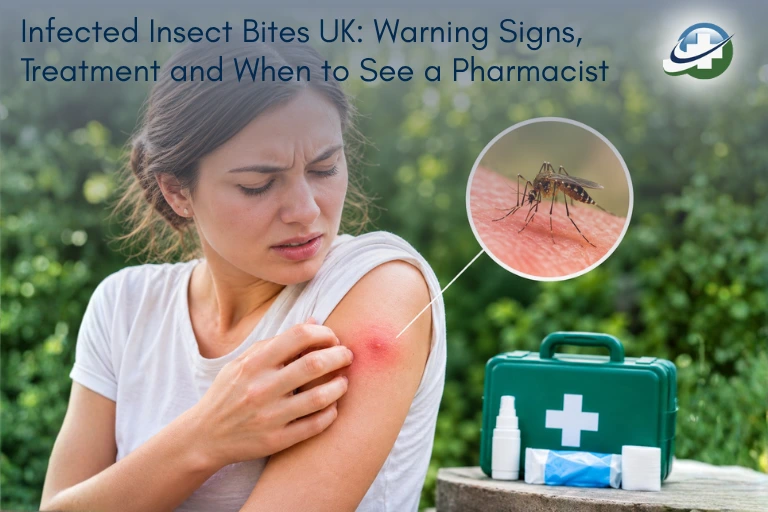
Insect bites are part of life in the UK, especially from late spring through to early autumn. Most of the time, a bite settles down on its own within a day or two. But sometimes the skin around a bite starts to look angrier, not better. The redness spreads, the area becomes hot and swollen, and it hurts more than it should. That is when an infected insect bite needs proper attention.
This guide covers everything you need to know about infected insect bites UK residents commonly experience: what the warning signs look like, how to treat an infected bite at home, and exactly when to see a pharmacist or seek urgent care.
Table of Contents
- What Is an Infected Insect Bite?
- Common Insects That Bite in the UK
- Warning Signs: How to Tell If a Bite Is Infected
- Normal Reaction vs Infected Bite: Key Differences
- How to Treat an Infected Insect Bite at Home
- Benefits of Seeking Early Treatment
- When to See a Pharmacist Under NHS Pharmacy First
- When to Go to A&E or Call 999
- Common Mistakes to Avoid
- Best Practices for Preventing Bite Infections
- FAQ: Infected Insect Bites UK
- Get Help Today
What Is an Infected Insect Bite?
Most insect bites trigger a normal immune response: some redness, mild swelling, and itching that settles within a couple of days. An infection is different. It happens when bacteria, most commonly Staphylococcus aureus or Streptococcus, enter the skin through the bite wound and begin to multiply.
This can happen because the bite was scratched, because it was not kept clean, or simply because the bite itself caused enough skin disruption to allow bacteria in. Children are especially prone to infected bites because scratching is almost instinctive.
Recognising infected insect bites UK residents need to act on early is the key to a quick recovery. The earlier you catch it, the simpler the treatment.
Common Insects That Bite in the UK
Knowing which insects are responsible helps you assess risk and respond appropriately. The most common biting insects in the UK include:
- Midges and gnats – particularly active in Scotland and rural areas, their bites tend to cluster and itch intensely
- Mosquitoes – more prevalent in summer, especially near rivers, ponds, and standing water
- Horse flies – their bites are painful because they cut rather than pierce the skin, making them more prone to secondary infection
- Fleas – typically brought in by pets; bites often appear in clusters around the ankles and lower legs
- Bed bugs – bites appear in lines or clusters on exposed skin and are often noticed after waking
- Wasps and bees – technically stings rather than bites, but the site can still become infected if the skin is broken or not kept clean
- Ticks – found in long grass and woodland areas; require careful removal and carry their own risk of Lyme disease
If you have recently returned from abroad, it is also worth noting that some bites acquired in tropical or subtropical regions can carry pathogens not typically found in the UK. Always mention recent travel when speaking to a pharmacist or GP.
Warning Signs: How to Tell If a Bite Is Infected
This is the most important section in this guide. Knowing the infected bite symptoms that signal a problem can make the difference between a simple pharmacy consultation and a trip to hospital.
Early Signs of an Infected Insect Bite
These typically develop within 24 to 72 hours of the bite:
- Redness that spreads outward from the bite site rather than fading
- Swelling that worsens after the first 24 to 48 hours instead of reducing
- Skin that feels hot to the touch around and beyond the bite area
- Increasing pain or tenderness rather than the itching easing off
- Pus or discharge weeping from the wound
- A yellow or honey-coloured crust forming over the bite site
More Serious Signs That Need Urgent Attention
- Red streaks radiating outward from the bite (a sign the infection is spreading through the lymphatic system)
- High temperature or fever above 38°C
- Swollen lymph nodes close to the bite
- Feeling generally unwell, shivering, or experiencing confusion
- A widespread rash appearing elsewhere on the body
If you notice any of these more serious symptoms, do not wait for a routine appointment. See a healthcare professional the same day.
Normal Reaction vs Infected Bite: Key Differences
One of the questions people ask most often is whether what they are seeing is just a standard reaction or something that needs treatment. This table breaks it down clearly.
| Feature | Normal Reaction | Infected Bite |
| Redness | Small and contained, fades within 24 to 48 hours | Spreads and worsens beyond 48 hours |
| Swelling | Mild, peaks early then reduces | Continues to grow or does not reduce |
| Pain and itching | Itchy, mildly uncomfortable | Painful and tender to the touch |
| Skin temperature | May feel slightly warm initially | Hot and inflamed around the area |
| Discharge | None | Pus, weeping fluid, or yellow crust |
| Fever | Absent | Possible in moderate to severe infection |
| Duration | Resolves within 1 to 5 days | Does not improve without treatment |
| Red streaks | Absent | May be present — an urgent warning sign |
If your bite matches the right-hand column at 48 hours or beyond, it is time to seek infected skin bite treatment from a qualified professional.
How to Treat an Infected Insect Bite at Home
For mild cases where infection is only beginning, or while you are waiting to see a pharmacist, these steps help manage symptoms and prevent the situation from getting worse.
Step 1: Wash the Area Gently
Use mild soap and clean water. Pat the skin dry rather than rubbing it. Do this twice a day to reduce bacteria at the bite site.
Step 2: Apply a Cold Compress
A clean cloth soaked in cool water, or an ice pack wrapped in a towel, applied for 10 to 15 minutes helps reduce swelling and takes the edge off the urge to scratch.
Step 3: Stop Scratching
This is the single most important thing you can do. Scratching breaks the skin further, introduces more bacteria from under your fingernails, and delays healing significantly. Keep nails short and consider lightweight cotton gloves at night for young children.
Step 4: Elevate the Affected Area
For bites on arms or legs, raising the limb above the level of your heart reduces swelling driven by fluid pooling in the tissue.
Step 5: Cover It Loosely
A breathable dressing protects the site from further contamination while allowing the skin to breathe. Avoid airtight dressings that trap moisture and encourage bacterial growth.
Step 6: Monitor for 48 Hours
Check the bite regularly for the first two days. Taking a photo every 12 hours and comparing them is a practical way to track whether the redness is spreading. If it is growing, that is your cue to get professional help.
One thing to avoid completely: do not squeeze, burst, or try to drain any pus yourself. This risks pushing the infection deeper into the tissue.
Benefits of Seeking Early Treatment
Acting early on an infected insect bite matters more than people often realise.
Faster recovery. Infections caught at an early stage respond more quickly to treatment than those left to develop over several days.
Prevents spread to deeper tissue. Left untreated, a surface-level skin infection can develop into cellulitis, a deeper infection of the skin and underlying tissue that takes considerably longer to resolve.
Reduces the need for stronger treatment. Mild infections caught early may respond to topical treatment. Delayed infections are more likely to require oral antibiotics, and serious cases may need intravenous treatment in hospital.
Eliminates the risk of sepsis. In rare cases, an untreated skin infection can enter the bloodstream. This is a medical emergency. Treating the infection early removes this risk entirely.
Less scarring. Bites that become significantly infected before treatment are more likely to leave permanent marks. Early treatment preserves the skin.
Clarity and peace of mind. A pharmacist consultation gives you a clear clinical picture of what you are dealing with and what you need to do. That certainty is genuinely valuable, especially for worried parents.
When to See a Pharmacist Under NHS Pharmacy First
The NHS Pharmacy First scheme allows community pharmacists to assess and, where clinically appropriate, provide treatment for a defined set of common conditions without needing a GP appointment. Infected skin bites are included in this scheme.
Who Can Access This Service?
NHS Pharmacy First for infected skin bites is available for patients aged 1 year and over. It is free at the point of use under the NHS.
What Happens During the Consultation?
Your pharmacist will examine the bite and assess the degree of redness, swelling, and any discharge present. They will ask how long ago the bite occurred, how symptoms have changed, whether you have any known allergies, and briefly review your relevant medical history. Where treatment is clinically indicated, they can provide it during the same visit.
At Burnham Health Pharmacy, the NHS Pharmacy First service for infected skin bites is available for adults and children aged 1 year and over. The team provides a same-day clinical assessment in a welcoming, professional setting with no GP referral required.
When Is a Pharmacist the Right First Step?
- The bite has not improved after 48 hours of careful home care
- Redness, swelling, or pain is getting worse rather than better
- Pus or discharge has appeared at the bite site
- You cannot get a same-day GP appointment but the bite needs looking at today
- A child aged 1 or over has a bite that is showing signs of infection
Walk-in appointments for NHS Pharmacy First conditions are available at Burnham Health Pharmacy, making it one of the most convenient options for same-day care in the area.
When to Go to A&E or Call 999
Some situations are beyond the scope of a pharmacy consultation and require emergency care immediately. Call 999 or go straight to A&E if you experience:
- Difficulty breathing or swallowing
- Swelling of the face, lips, tongue, or throat
- Dizziness, fainting, or a very rapid heartbeat
- A widespread rash appearing quickly across the body
These are classic signs of anaphylaxis, a severe allergic reaction that is life-threatening without immediate treatment.
Also seek urgent care by calling NHS 111 or going to A&E if:
- Red streaks are spreading outward from the bite (possible cellulitis or lymphangitis)
- You have a high fever alongside a visibly worsening bite
- You feel confused, extremely unwell, or are showing signs of sepsis
You can also check the NHS guidance on insect bites and stings for a clinically reviewed reference on symptoms and when to seek different levels of care. If you are ever unsure, call 111 and describe your symptoms. They will direct you to the right level of care quickly.
Common Mistakes to Avoid
These are the errors people most commonly make with infected insect bites UK-wide. Avoiding them gives your skin the best chance of healing without complication.
Waiting too long before getting help. A bite that looks manageable on Monday can look considerably worse by Wednesday. Use 48 hours as your decision point: if it is not clearly improving, get it seen.
Scratching the bite. This is the most common way a normal bite becomes an infected one. The bacteria under fingernails are sufficient to start or worsen an infection.
Using unproven home remedies. Toothpaste, vinegar, and similar suggestions circulate online but have no clinical evidence to support them. Some can irritate the skin or cause an additional reaction. Stick to clean water and mild soap.
Squeezing or draining pus yourself. This pushes bacteria into deeper tissue and can significantly worsen the infection. Leave it for a clinician to assess.
Stopping treatment before the course is finished. If you are given a treatment course, complete it fully even if the bite looks much better. Stopping early can allow the infection to return, sometimes in a more treatment-resistant form.
Ignoring bites acquired abroad. If you have returned from a country where insect-borne diseases are more common, mention your travel history when you speak to a pharmacist or GP. Certain bites from abroad require a different clinical pathway. For future trips, it is worth reviewing the travel clinic services at Burnham Health Pharmacy to ensure you are protected before you go.
Underestimating the location of the bite. Bites near the eye, on the face, over a joint, or on the hands carry additional risks and should be seen sooner rather than later regardless of how they currently look.
Best Practices for Preventing Bite Infections
Prevention works at two levels: avoiding bites in the first place, and stopping a bite from becoming infected once it happens.
Avoiding Bites in the UK
- Apply insect repellent when spending time outdoors, particularly at dawn and dusk when insects are most active
- Cover exposed skin during peak insect activity periods and near water
- Keep windows and doors screened during summer months
- Check yourself and your children for ticks after walking through long grass or woodland
- Remove ticks promptly using a proper tick removal tool, pulling straight upward without twisting
Stopping a Bite Becoming Infected
- Clean any bite as soon as you notice it using soap and water
- Resist the urge to scratch; use an antihistamine to reduce itching if needed
- Keep the area covered with a clean, breathable dressing
- Monitor the site for the first 48 hours and act if redness or swelling increases
- Maintain good general hygiene, particularly washing hands before touching the bite area
If you are planning travel to a destination where insect-borne diseases are a real risk, some conditions such as dengue fever, chikungunya, and tick-borne encephalitis can be prevented through vaccination. The travel clinic at Burnham Health Pharmacy offers a full range of travel vaccinations and personalised pre-travel health consultations to help you stay protected wherever you are heading.
FAQ: Infected Insect Bites UK
What are the clearest signs that an insect bite is infected?
The clearest signs are redness that spreads beyond the original bite area, swelling that gets worse after 48 hours rather than better, skin that feels hot to the touch, pain or tenderness at the site, and any discharge or pus from the wound. A fever alongside these local symptoms is a sign the infection may be spreading and needs same-day care.
How long does an infected insect bite take to heal with treatment?
With appropriate treatment, most infected insect bites UK patients present with will begin to improve within 48 to 72 hours and clear up fully within 7 to 10 days. More significant infections may take longer depending on the severity and the tissue involved.
Can a pharmacist treat an infected insect bite without a GP referral?
Yes. Under the NHS Pharmacy First scheme, community pharmacists can assess and provide clinical treatment for infected skin bites for patients aged 1 year and over without any GP referral needed. This makes it one of the fastest routes to appropriate care for this condition.
Is an infected insect bite dangerous?
Most infected bites are not dangerous when treated promptly. The risk increases when infection is left untreated and spreads to deeper tissue, potentially leading to cellulitis or, in rare cases, sepsis. Acting within 48 hours of noticing infection signs keeps the risk very low.
What is the difference between an infected bite and an allergic reaction?
An allergic reaction typically develops quickly after the bite, often within minutes to an hour, and produces symptoms such as hives, widespread swelling, or breathing difficulties. An infected bite develops more slowly over hours or days and causes localised redness, warmth, pain, and pus. In some cases both can occur together.
Can children use NHS Pharmacy First for infected bites?
Yes. The service is available for children aged 1 year and over. For bites involving very young babies, a GP or health visitor is the more appropriate first contact.
What should I do about a tick bite specifically?
Remove the tick using a tick removal tool, pulling straight upward without twisting. Clean the site with soap and water. Monitor for an expanding ring-shaped rash or flu-like symptoms appearing days or weeks later, as both can indicate Lyme disease. If either develops, see your GP.
Can an insect bite lead to impetigo?
Yes. Repeatedly scratched bites can develop into impetigo, a contagious bacterial skin infection that produces a distinctive honey-coloured crust. Impetigo is also covered under the NHS Pharmacy First scheme. You can find out more about impetigo symptoms and treatment options on the Burnham Health Pharmacy website.
Do infected insect bites always need antibiotics?
Not always. Mild infections may respond to topical treatment. More significant infections are more likely to require oral antibiotics. Your pharmacist will assess what is clinically appropriate during your consultation and will refer you to a GP if the infection is beyond the scope of pharmacy treatment.
Can I be seen at the pharmacy on the same day?
At many pharmacies, including Burnham Health Pharmacy, walk-in consultations for NHS Pharmacy First conditions are available on the same day. Calling ahead to confirm availability is always a good idea, but in most cases you will not need to wait days for an appointment.
Get Help Today
An infected insect bite is not something to sit on indefinitely. Most cases are straightforward when they are caught early. The difference between a quick pharmacy consultation and a more complicated situation almost always comes down to how quickly you act after the first signs appear.
If you are in the Slough, Burnham, or surrounding area and you have a bite that is not improving, or that is showing any of the warning signs covered in this guide, the team at Burnham Health Pharmacy is ready to help. As an NHS Pharmacy First provider, the pharmacy can assess your bite, provide clinical treatment on the day where appropriate, and refer you onward if needed. No GP appointment, no long wait, no fuss.
Visit: 30 High Street, Burnham, SL1 7JP
Call: 01628 603 170
Book online: burnhamhealthpharmacy.co.uk/booking
Do not let a bite become something bigger. Contact the team at Burnham Health Pharmacy today and get the right care quickly.