
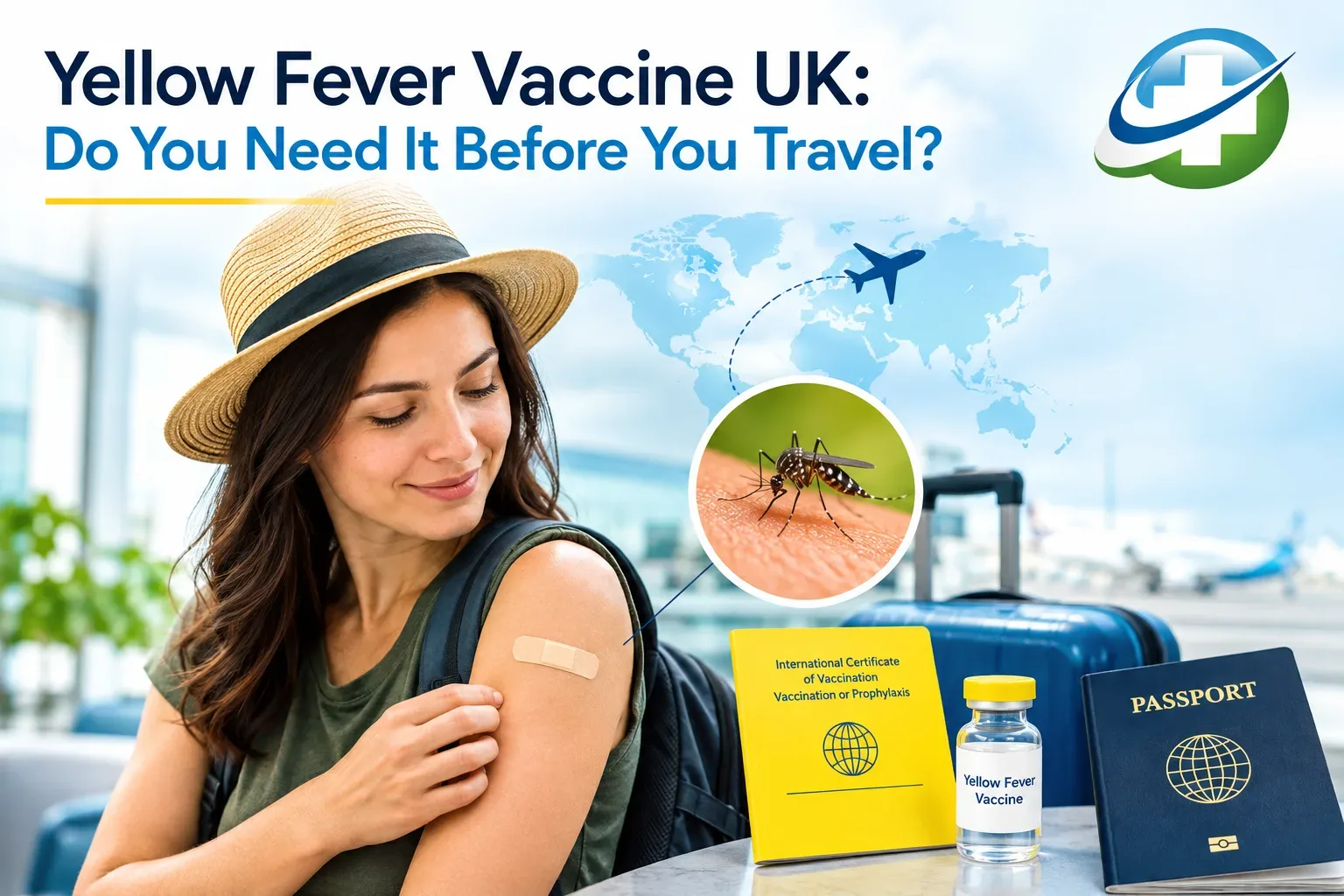
Whether you need the yellow fever vaccine UK health guidance recommends depends entirely on where you’re travelling, not on personal choice. Some countries require formal proof of vaccination before they’ll let you enter. Others don’t require it but sit in an area where the disease is present, which makes vaccination a sensible precaution rather than a legal requirement. Knowing which situation applies to your trip is the first thing to check before you book anything else.
What Is the Yellow Fever Vaccine UK and Who Needs It
Yellow fever is a viral infection spread by mosquito bites, found mainly in parts of sub-Saharan Africa and tropical South America. For most people it causes a short, flu-like illness, but in a small number of cases it can become severe. Because there’s no specific treatment once someone is infected, prevention through vaccination is the main line of defence.
You may need the vaccine if:
- You’re travelling to a country where yellow fever is present.
- Your destination country requires proof of vaccination for entry, even if you’re only passing through on a connecting flight.
- You’re travelling between countries where the disease is present, which can trigger entry requirements you wouldn’t expect from your final destination alone.
If none of this applies to your route, you likely don’t need it. But because entry rules can be tied to your flight path rather than just your final stop, it’s worth checking your full itinerary rather than assuming.
Countries That Require Proof of Yellow Fever Vaccination
Entry requirements around yellow fever generally fall into two categories, and mixing them up is one of the most common travel planning mistakes.
Entry Requirements vs Risk-Based Recommendations
Mandatory entry requirement: Some countries will not let you in without seeing a valid vaccination certificate. This is a border control rule, and it applies regardless of how healthy you feel or how short your visit is.
Risk-based recommendation: Other countries have areas where yellow fever is present, but don’t formally demand a certificate at the border. Vaccination is still strongly advised here for your own protection, even though it isn’t a condition of entry.
Because these rules can change and vary by region within a single country, always check current requirements for your specific route rather than relying on general assumptions. A travel health consultation is the most reliable way to get this confirmed for your actual itinerary, and it’s something you can arrange through our Travel Clinic Services.
How the Vaccine Works and When to Get It
The yellow fever vaccine works by prompting your immune system to recognise and defend against the virus before you’re ever exposed to it. For most adults, a single dose gives long-term protection, which is why international health regulations now treat one valid vaccination as lifelong proof for travel purposes.
Why Timing Matters Before You Fly
Your body needs time to build protection after vaccination, and your certificate only becomes valid a set number of days afterward, not on the day you receive it. This means last-minute vaccination often isn’t an option if your destination requires the certificate at the border. Booking your travel health appointment as early as possible, ideally as soon as you have confirmed travel dates, gives you the best chance of being fully covered and certified in time.
Possible Side Effects and Who Should Avoid It
Like any vaccine, mild reactions are possible, such as soreness where the injection was given, a headache, or feeling generally tired for a day or two afterward. These usually pass quickly on their own.
The vaccine isn’t suitable for everyone. It’s generally not given to babies under a certain age, and it needs individual discussion for people who are pregnant or breastfeeding, and for anyone with a weakened immune system or certain allergies. This is exactly the kind of detail worth raising directly during a pre-travel consultation, since suitability depends on your personal medical history rather than a one-size-fits-all rule.
Getting Your International Certificate of Vaccination
Once you’ve been vaccinated, you’ll be issued an International Certificate of Vaccination or Prophylaxis. This is the document border officials will ask to see if your destination has a mandatory entry requirement, so it’s worth treating it with the same importance as your passport when you pack.
Keep both a physical copy and a photo or scan saved somewhere accessible, such as your phone or email, in case the original is misplaced during your trip.
Planning Your Full Travel Health Check with Burnham Health Pharmacy
Yellow fever is rarely the only thing worth checking before you travel to a region where it’s present. Many of the same destinations also carry a risk of other illnesses, so it’s worth reviewing your wider travel health needs at the same time rather than dealing with each one separately. For example, if you’re heading somewhere with yellow fever risk, it’s also worth checking whether you’re up to date on your Hepatitis A Vaccine and your Typhoid Vaccine, both of which are common considerations for the same travel routes.
Availability for yellow fever vaccination can vary by clinic and by date, so the most reliable way to confirm your options is to speak to our team directly. Visit our Travel Clinic Services page for an overview of what we cover, or get in touch to check current availability and book a pre-travel consultation before you finalise your trip.
FAQs
Which countries currently require a yellow fever certificate for entry?
Requirements vary and are updated periodically, so always check the current rules for your specific destination and any transit countries before you travel, rather than relying on what was required in the past.
How long does yellow fever vaccine protection last?
For most adults, a single dose provides long-term protection, and international health regulations now recognise one valid vaccination as sufficient for travel purposes in most cases.
Can pregnant women or babies get the yellow fever vaccine?
This depends on individual circumstances and needs to be discussed directly with a healthcare professional, since suitability varies by age, health status, and specific travel risk.
What happens if I travel without the required certificate?
If your destination has a mandatory entry requirement, travelling without a valid certificate can result in being denied entry, or in some cases being vaccinated on arrival under less controlled conditions. It’s far safer and simpler to sort this out before you leave.