
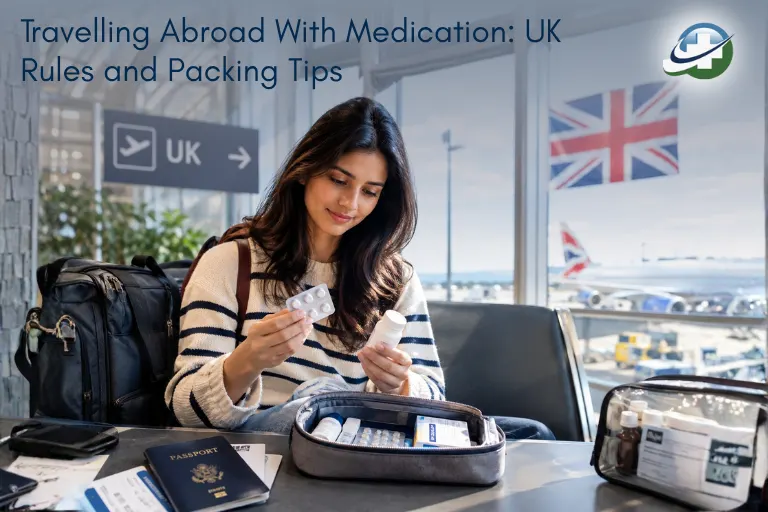
Before travelling abroad with medication, check the destination’s rules, carry medicines in their original packaging with a copy of your prescription, and pack them in your hand luggage. Some countries restrict certain medicines, including some controlled drugs, so you may need a letter from your prescriber or a licence. Start checking at least a few weeks before you go.
Most people can take their medicines abroad without any trouble. Problems usually come from three things: a missing label, a medicine that is restricted at the destination, or a checked bag that never arrives. This guide covers what to check, what to carry and how to pack. Many travellers from our area fly out of Heathrow, so we have also included what to expect at UK airport security.
If you are planning a trip and want a second pair of eyes on your medicine list, our travel clinic can go through it with you.
Can you take your medicines abroad?
In most cases, yes. The detail depends on the medicine and the country you are going to. Here are quick answers to the questions we hear most:
- Everyday over-the-counter medicines (paracetamol, antihistamines, rehydration sachets): Usually fine. Some cold remedies and painkillers contain ingredients that certain countries restrict, so check first.
- Prescription tablets and capsules: Yes, in the original packaging with your name and the dose on the label.
- Controlled drugs (some strong painkillers, ADHD medicines, and some sleeping tablets): Possibly, but you need to check the rules for both the UK and your destination before you go.
- Insulin and other injectables: Yes, in your hand luggage, ideally with a letter from your prescriber.
- Liquid medicine in containers over 100 ml: Yes, if it is essential for your journey and you can show proof it is prescribed to you.
- Anti-malaria tablets: Yes, and you will usually need to start them before you travel. Our guide to anti-malaria tablets explains how they work and when to start.
Pre-travel checklist
- Check your destination’s rules for each medicine you take.
- Ask your prescriber whether you need a letter.
- Check you have enough medicine for the whole trip, plus a few spare days.
- Keep medicines in their original packaging.
- Pack everything you need in your hand luggage.
- Write down the generic (active ingredient) name of each medicine.
- Plan your dosing around any time zone changes.
For wider trip planning, our travel health advice before international travel covers vaccines, insurance and what to pack.
Check the destination’s rules early.
Rules differ from country to country, and a medicine you can buy at any UK pharmacy may be restricted somewhere else. Codeine-based painkillers, some ADHD medicines and some sleeping tablets are common examples.
Start with these three sources:
- GOV.UK foreign travel advice. Look up your destination at GOV.UK and read the entry and customs sections.
- The destination’s embassy or consulate in the UK. This is the most reliable source for what they allow. GOV.UK keeps a list of foreign embassies in the UK.
- GOV.UK guidance on controlled drugs. If any of your medicines are controlled drugs, read the government’s guidance on travelling with controlled drugs. Whether you need a Home Office licence depends on how long you will be away and how much you are carrying, so check the current rules for your situation.
Do this early. A licence or a reply from an embassy can take time, so we suggest starting at least a few weeks before you travel. If your trip is close, our post on last-minute travel preparation explains what can still be done.
Also check any countries you will pass through on the way. A stopover can be subject to the same rules.
What paperwork to carry?
Do you need a letter to take medication abroad? Not always. But you should carry one if you take a controlled drug, use injectable medicines or needles, carry liquids over 100 ml, are taking a large amount, or your destination asks for one.
Here is what we suggest you carry:
- Original packaging with the pharmacy label showing your name, the medicine name and the dose.
- A copy of your prescription, or your repeat prescription slip.
- A letter from your prescriber on headed paper, signed and dated, listing your condition, each medicine by its generic name, the dose and the total quantity you are carrying.
- A list of your medicines with generic names, in case a local doctor or pharmacist needs to identify them.
- Any licence or permission you have been told you need for a controlled drug.
Take paper copies as well as photos on your phone. Phones run out of battery.
If you want your repeat prescriptions to run smoothly before you leave, you can nominate Burnham Health Pharmacy and we will help you plan your supply.
Packing and storing medicines
Pack more than you think you need. Take enough for the whole trip plus a few extra days in case of delays. For many travellers, the extra days are the most useful part of the plan.
Keep every medicine in its original box, not loose in a pill organiser. Organisers are handy at your destination, but they make it hard for security staff or a doctor to tell what you have.
Our post on how to store your medicines safely covers the basics, such as keeping medicines away from heat, damp and direct sun. These matter more on holiday, when a bag can sit in a hot car or on a beach.
Hand luggage and airport security
Carry everything you need for the journey in your hand luggage. That way a lost or delayed hold bag does not leave you without medicine. Split supplies between two bags if you are travelling with someone, so one lost bag does not take everything.
At Heathrow and at other UK airports, security follows the same government rules. According to GOV.UK:
- You can carry essential medicines over 100 ml in hand luggage, including liquid medicines and inhalers.
- You need proof the medicine is prescribed to you if it is a liquid in a container over 100 ml. A letter from your doctor or a copy of your prescription works.
- You do not need proof for tablets or for liquids in containers of 100 ml or less.
- Hypodermic syringes are allowed in hand luggage and in the hold.
- There are different rules for medicine that contains a controlled drug.
Airport staff may open containers to screen liquids, and each airport and airline has some discretion, so tell the security officer about your medicines at the start of screening and allow extra time. If you carry a lot of medicine or medical equipment, contact your airline before you fly.
Temperature-sensitive medicines such as insulin
Insulin and some other medicines need careful handling.
- Keep insulin in your hand luggage, not the hold. The hold can get cold enough to damage insulin, and a lost bag means a lost supply.
- Carry spare pens or vials beyond what you expect to use, and split them between bags.
- Bring a letter from your prescriber that lists your insulin and any needles or pumps. Security staff or airlines may ask for it.
- Avoid heat. Do not leave insulin in a parked car or in direct sun. A cooling pouch designed for insulin can help on hot days.
- Ice packs: Cooling gel packs are allowed. Frozen ice packs in hand luggage are not always allowed, so contact the airport in advance.
- Check the label. Some medicines need the fridge at your destination. Ask your hotel or host if there is one you can use.
If you use an insulin pump, a continuous glucose monitor or other devices, tell the airline and security staff, and ask your diabetes team how to handle body scanners.
Time zones and keeping to your dosing schedule
Crossing time zones can disrupt your dosing. For many medicines, taking them at roughly the same time of day is enough, and a gap of an hour or two is fine. For others, timing matters.
Speak to your pharmacist or prescriber before you travel if you take any of these:
- Insulin or other diabetes medicines
- Blood thinners
- Epilepsy medicines
- Medicines for Parkinson’s disease
- Contraceptive pills
- Any medicine where a late or doubled dose could cause harm
A simple way to plan it: write down your usual dose times in UK time, then work out with your pharmacist what they will be at your destination. Keep your watch or phone on UK time for the first day if it helps, and set alarms. Never double up on a dose to make up for a missed one unless you have been told it is safe.
What to do if you lose or run out of medicine abroad
Stay calm. This is fixable in most countries, but acting early helps.
- Find a local pharmacy or doctor. Show them your packaging, your prescriber’s letter and your list of generic names. Brand names often differ between countries, so the generic name is what they need.
- Call your travel insurer. Many policies help with the cost of replacing lost medicine and urgent care. Check yours before you go.
- Contact your UK prescriber or pharmacy. They may be able to send a letter or details to a doctor abroad.
- Do not buy from unregulated sellers. Fake and poor-quality medicines are a real risk in some places.
- Be aware you may need a local prescription. Some medicines you take in the UK may not be available abroad, or may only be available under a different name or strength.
If you are unwell after you return, our post on feeling unwell after travel explains when to see a pharmacist.
Frequently asked questions
Can I take prescription medicine on a plane?
Yes. Carry it in your hand luggage in its original packaging. GOV.UK says you do not need to show proof for tablets, but you do need proof, such as a prescription copy or a doctor’s letter, for liquids in containers over 100ml. Controlled drugs have extra rules.
Do I need a letter from my GP?
Not always, but it is a good idea if you take controlled drugs, injectables, liquids over 100ml, or a large amount of medicine. Some destinations also ask for one. Your prescriber can write it, and some practices charge a fee, so ask early.
Can I take more than one month of medicine abroad?
Often yes, but it depends on the medicine, the length of your trip and what your prescriber is willing to supply. Speak to your GP and our pharmacy team well before you travel. For long trips, and for controlled drugs, there are extra rules, so check the current GOV.UK guidance and plan ahead.
How do I travel with insulin?
Keep it in your hand luggage, not the hold. Carry spares, split between bags, and bring a letter from your prescriber listing your insulin and any needles or devices. Keep it out of heat and out of the cold. Ask your diabetes team how to adjust doses if you cross several time zones.
What if my medicine is illegal in my destination?
Do not take it until you have checked. Contact the embassy of the country you are visiting and speak to your prescriber, who may be able to suggest an alternative or write a supporting letter. Do not post medicine to yourself or ask someone to bring it out later without checking the rules for that country as well.
Book a travel consultation
Planning a trip and taking regular medicines? Book a travel consultation at Burnham Health Pharmacy and bring your medicine list. Our pharmacists will check it with you, talk through your destination and help you plan your supply.
Book your appointment or call us on 01628 603 170. We are at 30 High Street, Burnham, SL1 7JP.